· By Brandon Boyd
Crawl Space Encapsulation vs Vapor Barrier — What's the Real Difference?
Vapor barrier and encapsulation are not the same thing. Here's exactly what each does, when each is appropriate, and why most Tennessee homes need the full encapsulation.
Walk into any Tennessee crawl space contractor’s office and you’ll hear “vapor barrier” and “encapsulation” used in confusingly similar ways. They are not the same thing. Knowing the difference will save you from getting upsold (or downsold) into the wrong system.
The one-sentence version
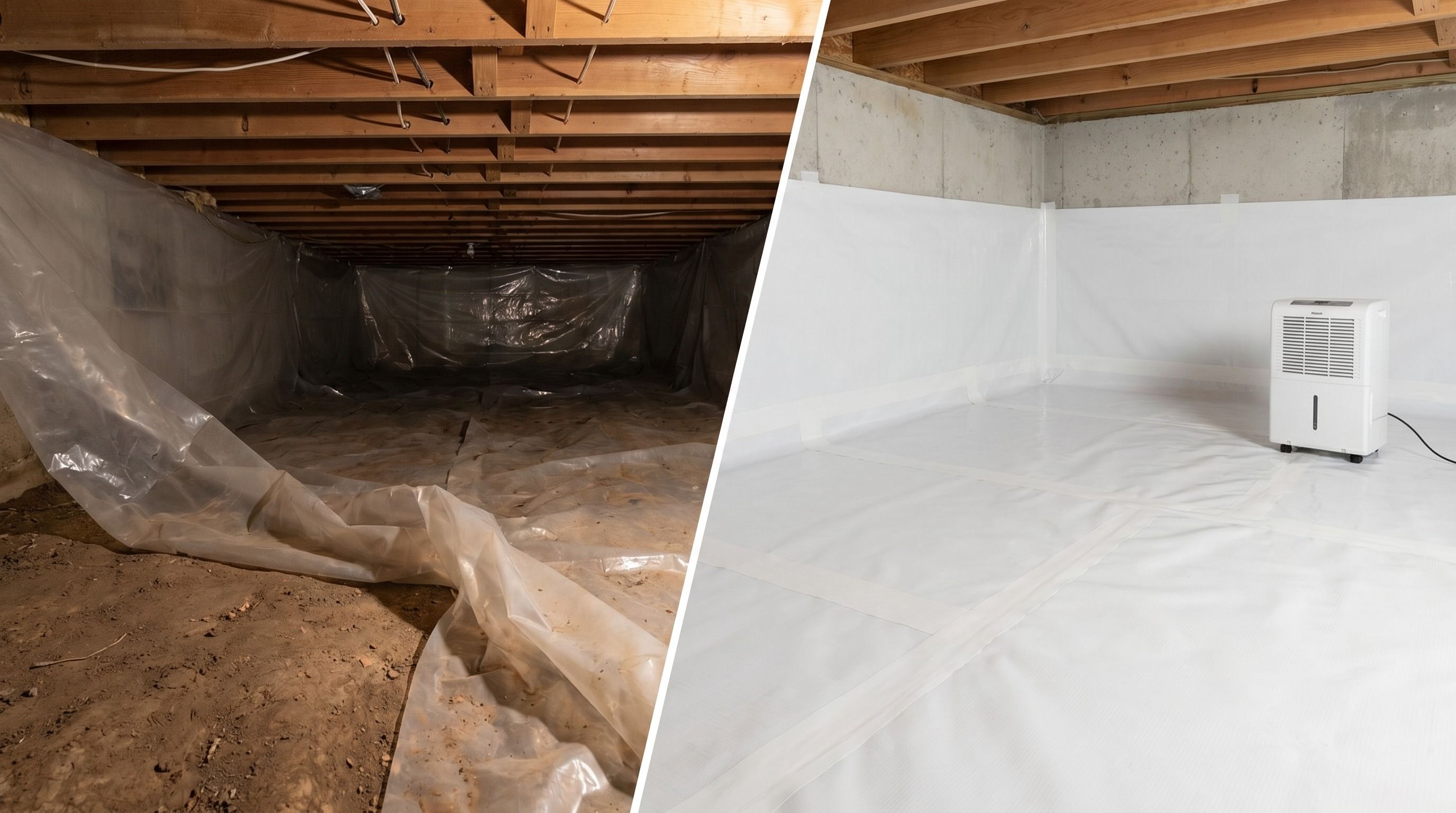
A vapor barrier is plastic sheeting on the crawl space floor. Encapsulation is a complete sealed system: vapor barrier on floor AND walls, sealed vents, sealed access door, and a dehumidifier to control humidity.
A vapor barrier is one component. Encapsulation is a system. Encapsulation includes a vapor barrier; a vapor barrier is not encapsulation.
What a vapor barrier actually does
A vapor barrier is a sheet of polyethylene plastic, typically 6 mil to 20 mil thick, laid across the dirt floor of a crawl space. Its job is one thing: stop moisture in the soil from evaporating directly upward into the crawl space air.
In a vented crawl space (the common pre-2010 Tennessee design), a vapor barrier:
- Reduces soil-source moisture by 50 to 90 percent depending on quality and install
- Does nothing about humid air entering through foundation vents
- Does nothing about humid air the home pulls in through the stack effect
- Does nothing about plumbing leaks or air conditioner condensate
- Does nothing about the humidity that’s already in the air
That last point is the key one. In Tennessee, the air inside a vented crawl space sits at 75 to 90 percent relative humidity for most of the year. A vapor barrier on the floor doesn’t change that. It only reduces the rate at which more moisture is added.
What encapsulation actually does
Encapsulation is the complete system. It includes:
- Heavy-duty vapor barrier on the floor (typically 12 to 20 mil, reinforced)
- Vapor barrier extended up the foundation walls to within 3 inches of the top
- Sealed seams with commercial seam tape
- Sealed penetrations for plumbing, support posts, electrical
- Sealed foundation vents — the original vents are closed off with insulated covers
- Sealed crawl space access door — replacing the typical wood access with a sealed insulated unit
- Commercial dehumidifier sized for the crawl space volume, with automatic drainage
- Verification that humidity stays below 60% (the threshold where mold growth halts)
Each component does work. Skip one and the system underperforms. The dehumidifier in particular is what turns a sealed-but-humid space into a controlled environment.
Why most Tennessee homes need encapsulation, not just a vapor barrier
Tennessee’s climate is the issue. From May through September, outdoor humidity averages 75 to 85 percent. The vented crawl space pulls that humid air in continuously. A vapor barrier on the floor does nothing about the humidity that’s already entering from above.
In drier climates (Arizona, parts of the Mountain West), a high-quality vapor barrier alone can be sufficient because the ambient humidity is naturally low. In Tennessee, it’s not. The dehumidifier is the part that makes the crawl space actually dry.
This is also why the question “do I really need the dehumidifier?” comes up so often. The honest answer for Tennessee: yes. Without it, you’ve spent thousands of dollars to slightly slow down a problem that requires active humidity control to actually solve.
When a vapor barrier alone might be enough
There are genuinely cases where a homeowner doesn’t need full encapsulation:
- New construction built to current code with a sealed conditioned crawl space — the vapor barrier is integrated and the rest of the system is HVAC-driven
- A crawl space connected to conditioned basement that’s already controlled by HVAC
- A vapor barrier replacement project on an existing functional encapsulation where the dehumidifier and seal are already in place
If your situation is “vented dirt crawl space, mid-century Tennessee home, humidity issues,” vapor barrier alone is not the right answer.
Cost comparison
For a typical 1,800 square foot Tennessee home with a vented crawl space:
- Vapor barrier installation only: $2,500 to $5,000
- Full encapsulation: $7,500 to $10,500
The vapor barrier seems cheaper. The question is whether it solves the actual problem. In most Tennessee crawl spaces, it doesn’t. Homeowners who buy a vapor-barrier-only solution often spend another $3,000 to $5,000 within 2 years to add the dehumidifier, seal the vents, and complete the system — for a total spend higher than if they’d done full encapsulation from the start.
How to tell which one a contractor is actually quoting you
When you receive a quote, look for these specifics:
Vapor barrier only quote will include:
- Polyethylene sheeting installation
- Some seam taping
- Maybe wall coverage to 12 to 18 inches up
Full encapsulation quote will include all of the above PLUS:
- Wall coverage to within 3 inches of the top (full height)
- Commercial dehumidifier with installation
- Foundation vent sealing
- Access door upgrade or sealing
- Humidity verification visit after install
If a quote says “encapsulation” but doesn’t include a dehumidifier, it’s a vapor barrier installation with marketing language attached. Ask the contractor to clarify.
Which one is right for your Tennessee crawl space?
The honest framework:
- Encapsulation: Vented crawl space in any Tennessee metro, any home over 10 years old, any home with current humidity issues, any home with visible mold or moisture damage.
- Vapor barrier upgrade: Already-encapsulated home where the barrier has aged out, new construction code compliance, or specific niche scenarios.
- Vapor barrier only as a complete solution: Rare. For Tennessee climate, almost never the right call.
A free inspection produces a written recommendation. If a contractor recommends vapor barrier only, ask them specifically what they expect your crawl space humidity to read 90 days after install. The honest answer for Tennessee is “still 70+ percent.” That’s not a fix.
Get the right system, not the cheapest one
Crawl space work is the kind of project where the cheapest option upfront costs more in the long run. Encapsulation done right protects your home for 20+ years. A vapor barrier alone in a Tennessee climate is a partial measure that defers the real fix.
Submit a free inspection request and ask the contractor to walk you through specifically why they’re recommending what they’re recommending. A good contractor will explain the tradeoffs clearly.
Related on this site
Tennessee metros