· By Brandon Boyd
Tennessee Crawl Space Code — What Homeowners Need to Know
How Tennessee's adopted building codes treat crawl space encapsulation, what permits apply, what contractor licenses to look for, and how to ensure your project meets state and county requirements.

Tennessee crawl space encapsulation work falls under a layered code framework: state-level energy code, county-level adoption of the International Residential Code, municipal modifications, and contractor licensing rules. Most homeowners never need to know the details — a qualified contractor handles compliance — but if you want to verify the work is being done right, here’s what applies.
What code governs Tennessee crawl space work
Tennessee uses a customized version of the International Residential Code (IRC), currently the 2018 edition with state amendments. Counties and cities can adopt newer editions individually. Practical situation:
- State minimum: 2018 IRC with state amendments
- Larger metro counties (Davidson, Knox, Hamilton, Shelby): Often the 2021 IRC
- Specific cities (Nashville, Knoxville, Chattanooga, Memphis): May add municipal amendments
For crawl space encapsulation specifically, the relevant sections are:
- IRC R408 (Under-Floor Space) — defines the requirements for both vented and unvented (encapsulated) crawl spaces
- IRC N1102 / IECC C402 — energy code requirements for crawl space insulation
- State amendments — minor Tennessee-specific modifications, usually relaxing requirements rather than tightening them
IRC requirements for encapsulated (unvented) crawl spaces
The code specifies what an “unvented” crawl space must include to be code-compliant:
Vapor retarder (R408.3.1)
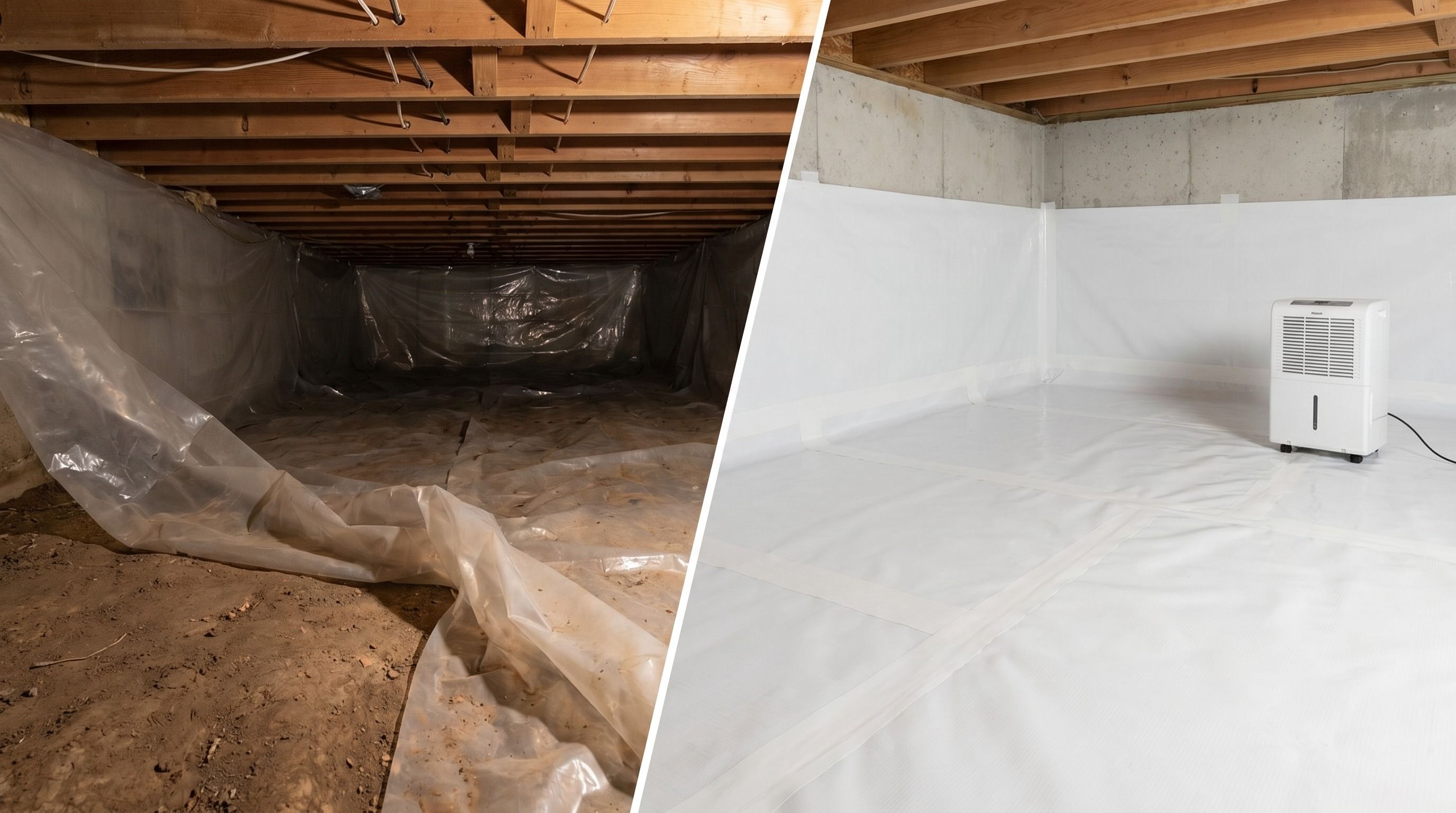
A Class I vapor retarder (in practice, the reinforced polyethylene barrier) must cover the entire ground surface. Joints must overlap by at least 6 inches and be sealed or taped.
The barrier must extend up the foundation wall at least 6 inches and be attached and sealed to the wall. Code minimum is 6 inches; modern best practice (and most contractor specs) is to extend to within 3 inches of the top of the foundation.
Conditioning requirement (R408.3.2)
A sealed (unvented) crawl space must have one of:
- Continuously operated mechanical exhaust ventilation at 1 cubic foot per minute per 50 square feet of floor area, with conditioned air supply, OR
- Conditioned air supply at 1 CFM per 50 square feet of floor area with a return-air pathway to the conditioned space, OR
- A dehumidifier sized for the volume of the space, maintaining humidity at or below 60%
Almost every Tennessee encapsulation uses option 3 because it’s the most efficient and requires no integration with the home HVAC.
Insulation (energy code)
Tennessee falls into IECC Climate Zone 3 (most of the state) or Climate Zone 4 (a few northern counties). For unvented crawl spaces:
- Climate Zone 3: Wall insulation R-5 continuous (or R-13 cavity fill if framed)
- Climate Zone 4: Wall insulation R-10 continuous (or R-19 cavity fill)
Closed-cell rigid foam board at 2 inches thick meets the requirement comfortably.
Permits — when they apply
Most pure crawl space encapsulation work does NOT require a separate permit because it’s classified as moisture control rather than structural work. However, common adjacent work that often goes with encapsulation DOES require permits:
- Electrical: Adding a dedicated circuit for the dehumidifier or sump pump requires an electrical permit and licensed electrician in most Tennessee jurisdictions.
- Plumbing: Drain line connections to the building drain system (rare but happens with some sump configurations) require a plumbing permit.
- Structural: Any beam, post, or joist work requires a building permit.
- Foundation: Modifications to the foundation (closing vents counts in some jurisdictions; not in others) may require a permit.
Larger jurisdictions (Davidson, Knox, Hamilton) tend to require electrical permits for new circuits. Smaller counties often don’t enforce permits on this scope.
A reputable contractor handles required permits as part of the project. If a contractor specifically tells you “no permits needed” without checking, that’s a warning sign.
Contractor licensing in Tennessee
Tennessee licenses contractors through the Tennessee Board for Licensing Contractors. The license matters more for the legal recourse it provides than for the technical work itself.
- Tennessee Contractor License (BC, BC-A, etc.): Required for any single project over $25,000 (the bonding threshold). Smaller projects don’t strictly require the license, but reputable encapsulation contractors carry it anyway.
- Tennessee Limited Licensed Plumber: Required for plumbing work over $25,000.
- Tennessee Limited Licensed Electrician: Required for electrical work over $25,000.
What to verify:
- Active license status at https://verify.tn.gov (free public lookup)
- Workers’ compensation insurance ($1M minimum typical)
- General liability insurance ($1M minimum typical)
- Bond status (for licensed contractors)
A contractor who can’t or won’t show you proof of these is not someone you should be hiring for a $7,500+ project in your home.
County-level specifics
Davidson County (Nashville)
Metro Codes adopts the 2018 IRC with Metro amendments. Permits required for any work involving electrical circuit additions. Permits inspected on rough-in and final. Online application available at the Metro Codes portal.
Knox County (Knoxville)
Knox County and the City of Knoxville follow IRC 2018. Permits for electrical work are required and inspected. The county’s online permit portal is reasonably efficient.
Hamilton County (Chattanooga)
Hamilton County and the City of Chattanooga follow the 2018 IRC. Permits required for electrical and plumbing scope. Inspections typical within 5 business days of request.
Shelby County (Memphis)
Shelby County follows the 2018 IRC. Permitting tends to be slower than the other major metros. Inspections can take 10+ business days during busy seasons.
Williamson County (Franklin)
Williamson County tends to enforce more rigorously than surrounding counties. Permits commonly required even for scope smaller jurisdictions would skip.
What “code-compliant install” actually looks like
When you compare contractor quotes, the code-compliant install will include all of these:
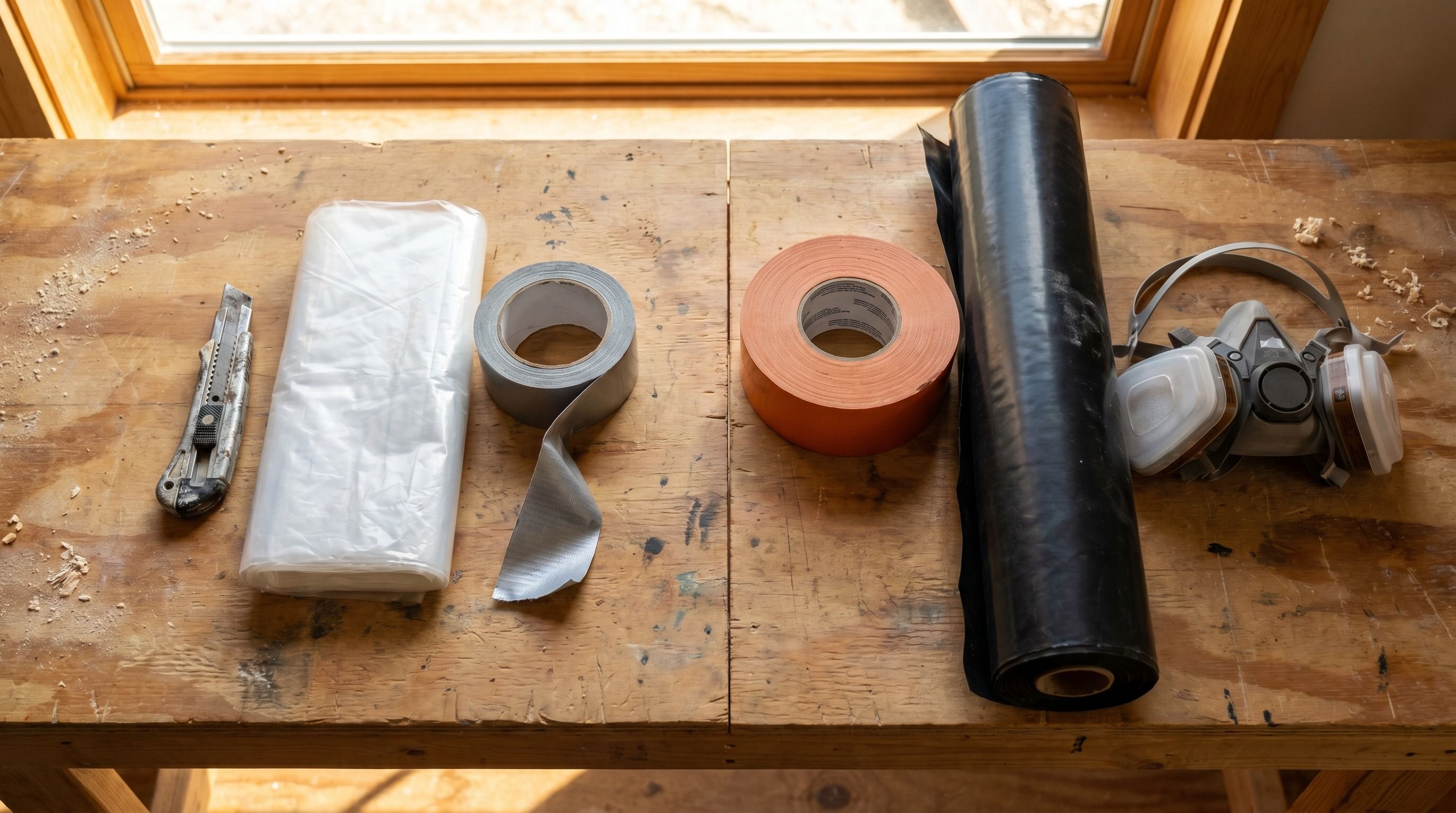
- Class I vapor retarder (12+ mil reinforced polyethylene)
- Floor coverage with 6+ inch seam overlaps
- Wall extension at least 6 inches up (most go to 3 inches from top)
- Mechanical attachment to foundation walls
- Sealed seams with commercial seam tape
- All penetrations sealed (plumbing, support posts, vents)
- Either continuous mechanical ventilation OR a dehumidifier sized for volume
- If insulating: meets Zone 3 or Zone 4 R-value requirements
A “budget” quote that skips wall extension, uses thinner non-reinforced barrier, or doesn’t include any conditioning mechanism is NOT code compliant. The work might pass visual review if no one inspects, but it doesn’t meet the IRC standard for an unvented crawl space.
When a structural engineer is needed
Rare for pure encapsulation work, but a structural engineer’s stamp may be required when:
- Significant floor joist or subfloor damage is discovered
- Foundation walls show structural issues
- Significant settlement is visible
- The work overlaps with a real estate transaction requiring documented certification
Cost: $400 to $1,200 for a residential engineer visit. Worth it for the specific situations above, unnecessary otherwise.
Why code compliance matters
Beyond the legal angle, code compliance is a proxy for install quality. The IRC requirements exist because building science has shown what works and what doesn’t. A contractor who skips code-required steps is also skipping the parts that make the system actually work.
When evaluating Tennessee crawl space contractors:
- Ask them which code edition their work follows
- Ask them how they handle permits for the electrical scope
- Ask them to itemize the install steps in the quote
- Verify their license at https://verify.tn.gov
A confident, knowledgeable answer to each of these is what you want.
If you’d like to be matched with a properly licensed Tennessee crawl space contractor who handles compliance correctly, submit a free inspection request through the form on this page.
Related on this site
Services
Tennessee metros